Who Was Hilda Murrell?

Hilda Murrell was born on 3 February 1906 in Shrewsbury, Shropshire in the West Midlands of England, and lived there all her life. The elder of two daughters, she came from a family of nurserymen, seedsmen and florists going back to 1837. Her grandfather Edwin Murrell established and ran Portland Nurseries until his death in 1908.
A gifted pupil at Shrewsbury Girls’ High School where she was head girl, Hilda won a scholarship to Newnham College, Cambridge (1924-27). She graduated with an MA in English and French literature, and Modern and Mediaeval Languages.
Having no brothers, in 1928 Hilda was persuaded by her father Owen to join what was by then a successful and well-known family rose nursery and seed shop business run by him and his elder brother Edwin Foley Murrell. She quickly developed outstanding horticultural and business skills, and took over as Director in 1937.
Her energy and organisational flair proved assets during World War II in her voluntary work for the care and resettlement of Jewish refugee children in Shropshire foster-homes and schools, making lifelong friends of some of those she helped. Her fund-raising efforts included arranging recitals in Shrewsbury by such world-famous performers as the pianist Dame Myra Hess and violinist Jelly d’Aranyi.
Under her management, Edwin Murrell Ltd enjoyed its final golden years from 1949-70. Hilda had become an internationally respected rose-grower and authority on rose species, old-fashioned varieties and miniature roses. The firm regularly won top awards at Chelsea and Southport Flower Shows as well as at the oldest annual flower show in the world in Shrewsbury. She sold roses to the Queen Mother and the Churchills, and helped Vita Sackville-West design her White Garden at Sissinghurst Castle in Kent. Her annual rose catalogue was widely known and respected both for its information and elegant writing; and she also designed many gardens. In a final tribute, David Austin gained her approval to name a rose after her just three weeks before she was murdered.
Walking, especially in hill country, was one of Hilda’s favourite leisure activities from an early age; and she had a passion for mountaineering and even rock-climbing until arthritis limited her in later life. With this she developed a deep concern to preserve the countryside and wildlife of the Welsh Marches. She was a founder-member of the national Soil Association promoting organic horticulture, and of what is now the Shropshire Wildlife Trust; and in the 1970s she worked unpaid with her customary energy for the Shropshire branch of the Council for the Protection of Rural England.
On her retirement in 1970, the rose business was sold and she had time and resources to devote to emerging environmental problems and threats to Shrewsbury ‘s rich architectural heritage. She also indulged her love affair with the Welsh Marches by building a Canadian cedarwood chalet high up on the Welsh side of Llanymynech Hill near Oswestry with a stunning view up the Tanat Valley to the Berwyn Mountains, where eventually her ashes were scattered.
She became an expert botanist, and extracts from her nature diaries were published in 1987 illustrated with her coloured photographs and brilliantly executed botanical drawings. She was also deeply knowledgeable about megalithic monuments and the history of the British landscape. Other enthusiasms included antiques, spinning and weaving, and birdwatching; and she was a skilled cook and dressmaker, and a voracious reader.
Hilda’s central concern in later life was for the growing pollution crisis in the environment. She brought together carefully researched knowledge, a deep love of the natural world, and an ability to anticipate threats to it. She was also an indefatigable and fearless campaigner to bring these issues to the attention of those who had the power and responsibility to effect solutions.
Having predicted the 1973 oil crisis, Hilda became increasingly concerned by the hazards posed by nuclear energy and weapons. With characteristic thoroughness, she began to research this highly technical field. In 1978, she wrote a paper entitled What Price Nuclear Power? in which she deployed her financial flair to challenge the economics of the civil nuclear industry. After the 1979 US accident at Three Mile Island, she turned her attention to safety aspects, and homed in on the problem of radioactive waste, the disposal of which she concluded was the industry’s Achilles heel. In 1982, the Department of the Environment published a White Paper (pdf) on the British Government’s policy on radioactive waste management.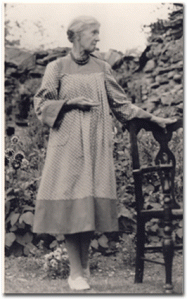
Hilda, now in her late 70s, wrote a critique of it, which she developed into her submission An Ordinary Citizen’s View of Radioactive Waste Management to the first formal planning inquiry into a nuclear power plant in Britain, the Sizewell B Pressurised Water Reactor in Suffolk.
Hilda’s Times obituary, by Charles Sinker, ended: “Her close friends remember her as a fierce but fundamentally gentle warrior, a Bunyan-like soul on a lonely and constant quest for the real path of the spirit. She died in tragic circumstances, alone in the empty countryside. It is an almost intolerable irony that a life so dedicated to peaceful pursuits, and to the pursuit of peace, should have been terminated by an act of mindless violence.”
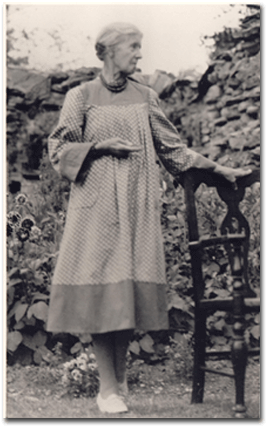
 Hilda Murrell
Who Killed Hilda Murrell? « Radio Litopia said
[…] show features an in-depth interview with her nephew, former Royal Navy Commander Robert Green. You will find it compelling listening. Robert’s book is available […]
Taking up Hilda’s Torch: Robert Green’s account of his contribution to the 1988/9 Hinkley C Inquiry. « nuclear-news said
[…] The Hilda Murrell website: https://hildamurrell.org/home/ […]